
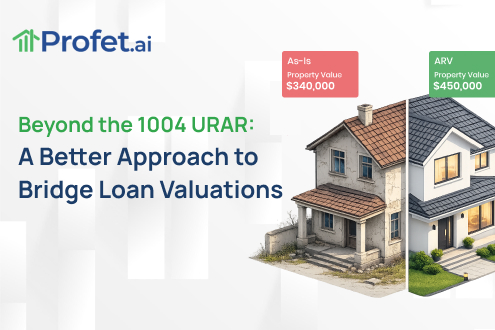
If you’ve ever originated or appraised a bridge loan or fix-and-flip deal, you already know the problem. The loan requires two values: what the property is worth right now, and what it will be worth after renovation. Yet the most widely used residential appraisal form in the United States — the Fannie Mae 1004 Uniform Residential Appraisal Report (URAR) — was never designed to document both in a single, coherent report.
The result? Appraisers produce workarounds. Lenders receive incomplete packages. Underwriters ask for revisions. Secondary market investors flag missing documentation. And everyone involved loses time and money on deals that could have closed faster with the right tools.
In this article, we’ll walk through exactly why the 1004 form falls short for bridge lending, what’s wrong with the legacy forms software appraisers use to build it, and how Profet.ai’s AI-powered valuation platform addresses every one of these gaps.
The Core Problem with the 1004 for Bridge Loans
The Fannie Mae 1004 URAR is the gold standard for traditional residential lending — specifically for loans that will be sold into the secondary market through Fannie Mae or Freddie Mac. It was designed to produce a single market value conclusion for a property in its current condition. It does that job well.
Bridge loans and fix-and-flip financing are a fundamentally different product. They are short-term loans that fund both the acquisition of a distressed or undervalued property and the rehabilitation needed to bring it to market condition. To underwrite these loans properly, lenders need two distinct valuations.
The gap the 1004 can’t fill: There is no native framework in the 1004 form for documenting both an as-is value (what the property is worth today, warts and all) and a separate after-repair value (ARV) — what the property will be worth once renovations are complete. Appraisers who try to produce both within the 1004 framework resort to addenda, cover letters, and unofficial workarounds that create ambiguity and compliance risk.
This isn’t a minor inconvenience. For private lenders, the as-is value determines how much can be safely lent at close. The ARV determines the exit value and the maximum loan-to-value against which interest carry and rehab draws are measured. If these two numbers aren’t clearly documented and defensible, the entire loan file is weaker — and harder to sell to downstream capital partners.
Why Appraisers Struggle With the 1004 in These Scenarios
It’s not just the form itself — it’s the ecosystem around it. When appraisers produce 1004 reports, they typically use legacy forms software platforms such as AlaMode, ACI, SFREP, or ClickForms. These platforms have been workhorses of the industry for years, but they were built in an earlier era of residential lending and their architecture reflects that.
Specifically, they suffer from three core limitations that become acute in private lending scenarios:
Data entry, not data intelligence. These platforms are fundamentally forms-filling tools. Appraisers must manually search the MLS, download comparable sales data, and then re-enter or import it into the appraisal form. This process is time-consuming and introduces transcription errors. There is no embedded intelligence to help identify the best comparables — just a blank grid waiting to be filled.
Rule-based checks, not AI-assisted quality control. The quality check features in legacy forms software are basic rule-based validators: flags for missing fields, out-of-range values, and formatting errors. They don’t understand the relationship between the subject property and its comparables. They can’t assess whether the appraiser’s adjustments are defensible. And they certainly can’t cross-reference a set of as-is comps against a set of after-repair comps for consistency.
No support for multi-scenario reports. Perhaps most critically, these platforms have no mechanism for managing two valuation scenarios within a single workflow. Every comp grid, every adjustment, every narrative section is designed around a single property in a single condition at a single point in time.
The Profet.ai Difference
Profet.ai’s Valuation Platform was built from the ground up for the realities of private lending, not the requirements of GSE-conforming loans. That distinction matters enormously in practice.
The core innovation: Profet.ai supports multiple valuation scenarios under a single loan order. Appraisers define the subject property once, complete an as-is valuation with its own set of comparables and adjustments, and then create an after-repair scenario where the property’s condition and features are updated to reflect the post-rehab state — with its own comp search, its own adjustments, and its own value conclusion. Both scenarios live in a single, unified report package.
This isn’t just a convenience feature. It fundamentally changes what a bridge loan appraisal looks like. Instead of two disconnected reports or a single report with workaround addenda, the lender receives a comprehensive document that clearly presents both the as-is and ARV conclusions with their full supporting analysis. Underwriters can review both values in context. Secondary market investors can assess the renovation thesis with the same level of rigor as the current value.
Six Platform Features That Matter for Private Lending
The dual-scenario workflow is the headline capability, but Profet.ai’s platform includes a set of AI-powered features that address specific pain points across the valuation process. Here’s what each one does and why it matters.
1. Embedded MLS Data
MLS listing data is integrated directly into the Profet platform. Appraisers search, review, and select comparables without ever leaving the workflow — no separate MLS tab, no CSV exports, no manual re-entry. This alone eliminates one of the most time-consuming and error-prone steps in the traditional appraisal process.
2. ML-Powered Comp Scoring
Profet’s machine learning models analyze every potential comparable sale in the market and rank them by similarity to the subject property across location, gross living area, age, condition, quality, and amenities. Scoring weights are configurable, so appraisers can tune the model to their local market.
3. Computer Vision Condition Ratings
Profet uses computer vision models that automatically analyze listing photos across the entire MLS and pre-assign a property condition and quality rating to every listing — making it fast to find comps that match the subject’s as-is condition and separately surface comps reflecting the post-rehab quality level.
4. Embedded HPI Time Adjustment
Comparable sales happened in the past. Profet includes an embedded Home Price Index model that provides localized, data-driven time adjustments for each comparable, replacing manual lookups and spreadsheet calculations.
5. Integrated QC via Profet Review
Profet Review is built directly into the production platform. Appraisers complete a full quality control pass on both scenarios before the report is delivered to the lender — fewer revision requests, faster delivery, and a cleaner record for the loan file.
6. Lender Engagement Rule Enforcement
Lender-specific underwriting requirements can be configured directly in Profet. When an appraiser’s work violates a lender rule, Profet flags it automatically and requires remediation before the order can be completed.
Side-by-Side: Profet.ai vs. the 1004 Workflow
Here’s a direct comparison of how Profet.ai stacks up against the standard 1004 form and legacy forms software across the capabilities that matter most for bridge loan and fix-and-flip appraisals.
| Capability | 1004 / Legacy Software | Profet.ai Platform |
|---|---|---|
| As-is & ARV in a single workflow | ✗ Not supported | ✓ Native dual-scenario |
| Inline MLS comparable data | ✗ Manual import / re-key | ✓ Fully embedded |
| Intelligent comp scoring & ranking | ▸ Rule-based, manual | ✓ ML similarity engine |
| Condition & quality rating from listing photos | ✗ Not available | ✓ Computer vision pre-tagging |
| Date-of-sale time adjustment via HPI | ▸ Manual calculation | ✓ Embedded HPI model |
| Appraisal QC integrated with production | ✗ Separate process / vendor | ✓ Profet Review built-in |
| Lender engagement rule enforcement | ✗ Post-delivery lender review | ✓ Pre-delivery auto-flagging |
| Investor-ready dual-scenario package✗ | Single scenario only✓ | ✓ Comprehensive package |
What the Profet.ai Bridge Loan Workflow Looks Like
In practice, here’s how an appraiser completes a bridge loan assignment on Profet.ai from start to finish.
Document the property’s current features, condition, and quality. Computer vision ratings from listing photos provide a useful starting point for condition classification.
ML scoring surfaces the most similar sales. Embedded MLS data means no manual imports. The HPI model adjusts for market time automatically.
A new scenario is created within the same order. The appraiser updates the property to its after-repair condition and finds comps reflecting the post-rehab quality level.
Who Benefits From Profet.ai
The advantages of this approach are felt across everyone in the bridge lending transaction ecosystem.
Private Lenders & Bridge Loan Originators
Receive a single, investor-ready appraisal package that documents both the as-is and ARV with full supporting analysis. Lender-specific underwriting rules can be embedded directly into Profet so appraisers remediate violations before delivery, reducing revision cycles and shortening time-to-close on every bridge and fix-and-flip deal.
Appraisal Management Companies (AMCs)
Manage and review higher appraisal volumes with built-in QC tools that surface issues automatically. The platform’s productivity features — embedded MLS, ML comp scoring, and computer vision ratings — allow your appraiser panel to complete complex private lending assignments faster without sacrificing quality or compliance standards.
Private Lenders & Bridge Loan Originators
Stop re-keying MLS data, stop running separate QC tools, and stop producing two disconnected reports for every bridge loan assignment. Profet’s unified workflow handles both the as-is and ARV in a single pass, with AI-assisted comp scoring and pre-delivery quality checks that make every report more defensible and every order more profitable.
Secondary Market Investors & Note Buyers
Profet.ai reports deliver the structured, dual-scenario documentation needed to assess loan file quality quickly. Both the as-is value and the ARV are supported by full comparable analysis, condition documentation, and market trend data — so you can underwrite faster and price risk with greater accuracy and confidence.
The Bottom Line
Profet.ai was built specifically for this environment. The dual-scenario workflow, the embedded MLS data, the ML-powered comp scoring, the computer vision condition ratings, the integrated QC, and the HPI time adjustment model all work together to produce appraisal reports that are faster to complete, more accurate, more compliant, and better suited to the documentation requirements of private capital markets.
The question isn’t whether the 1004 has served the industry well — it has, for decades, in the right context. The question is whether it’s the right instrument for bridge loan valuations. For the reasons outlined above, it isn’t. And now there’s a better alternative.
Learn more about how Profet.ai’s dual-scenario workflow can modernize your bridge loan valuation process for lenders, AMCs, and independent appraisers alike.