
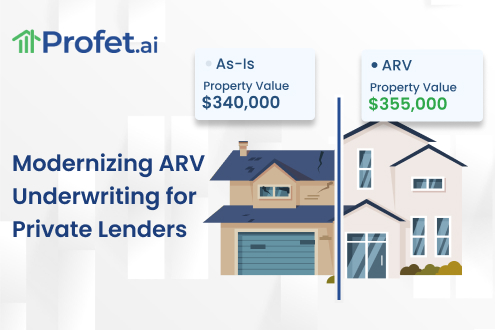
Private lenders offering Bridge loans rely heavily on As-Is and After-Repair value (ARV) of a property and face a mix of valuation, operational, and risk-management challenges. These issues are different from traditional agency lending because speed, renovation assumptions, and borrower execution risk play a much larger role. You aren’t just underwriting based on a property value and borrower risk; but you are betting on a future expectation which adds more complexities.
Bridge loans are short-term gap fillers that rely entirely on a solid exit strategy. Whether that exit is a fix-and-flip sale or a refinance, it all hinges on one critical number: the After Repair Value.
The Pain Points: “Renovation Valuation Complexity”
- Limited Data Insights: MLS data does not flag flipped properties and appraisers need to perform manual research to find them
- Comparable Research: Finding “renovated” comparable sales or comparable sales that are similar to the renovated subject property
- Inconsistent ARV methodologies: assumptions of the post-renovation condition and quality of construction.
- Documentation Gaps: Lack of standards and software facilities to document two distinct valuation models – As-Is and After-Repair, with distinct supporting information.
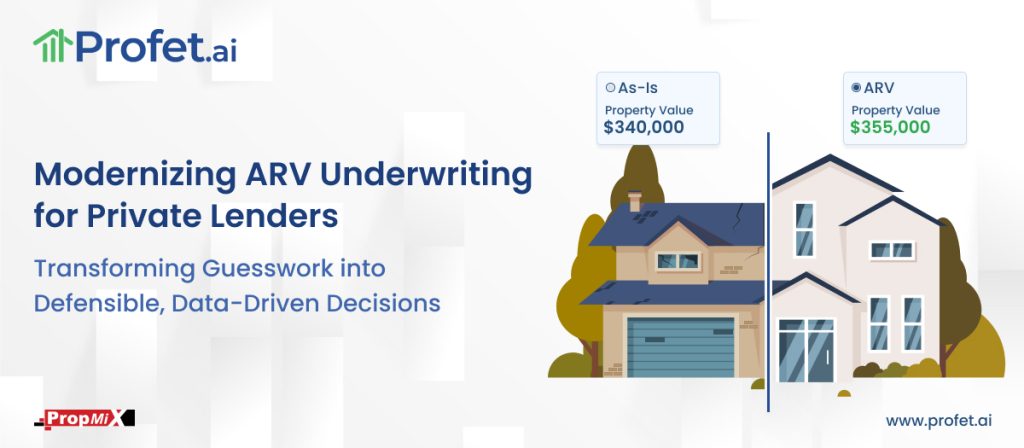
The Solution: Structured Intelligence for ARV
At PropMix, we’ve built the platform that powers bridge loan related valuation models with comprehensive research facilities.
Here is the exact Profet.ai Workflow that is helping lenders move from “application” to “term sheet” in record time:
Step 1: Prepare As-Is Valuation
Stop hunting for data. The moment a deal lands on your desk, our system helps you confirm the subject property’s current features and build an As-Is valuation – search for As-Is comps, apply adjustments and derive an As-Is value.
- The Benefit: All your comp research in one place – MLS listings, public record sales, images, market trends, and numerous search options.
Step 2: Create an After Repair Scenario
Make a copy of all the As-Is research you just did, and modify the subject property for its features after the repairs or improvements are completed – new condition, more GLA, new room count, quality ratings, etc.
- The Benefit: You create a distinct “Future State” scenario. This allows you to toggle between the current reality and the exit strategy.
Step 3: Prepare After Repair Valuation
Search for comparable properties that match the after-repair version of the subject property – condition, GLA, etc. Apply appropriate adjustments and develop a comprehensive valuation.
- The Benefit: Find other flipped properties, view before and after photos, and match condition and quality. Without impacting your As-Is valuation that you already completed.
Step 4: Reconcile & Produce Final Report
Profet will generate a report for you with 2 valuation models clearly separated with 2 sets of comp grids, and 2 distinct final values.
- The Benefit: Document the repair costs, reconcile the value increase, and even assess the margin for valuation risk.
Result: A Smarter Framework for ARV-Driven Lending
In bridge lending, there is no margin for ambiguity. Every deal is a calculated bet on execution, timing, and market acceptance — and that bet is only as strong as the valuation framework behind it. When As-Is and After-Repair values are derived through fragmented research, inconsistent assumptions, and manual reconciliation, lenders are left exposed to avoidable risk.
By separating present reality from future potential, standardizing ARV methodology, and embedding renovation logic directly into the valuation workflow, lenders can replace guesswork with defensible, data-driven underwriting. Profet.ai transforms the “Renovation Black Box” into a transparent, documented, and stress-tested process — allowing lenders to move faster without sacrificing rigor.